
How to Start a Successful Food Distribution Business in India
A complete step-by-step guide covering licenses, suppliers, inventory management, pricing and how technology can help you grow faster.
By Ashutosh Dubey4 min read
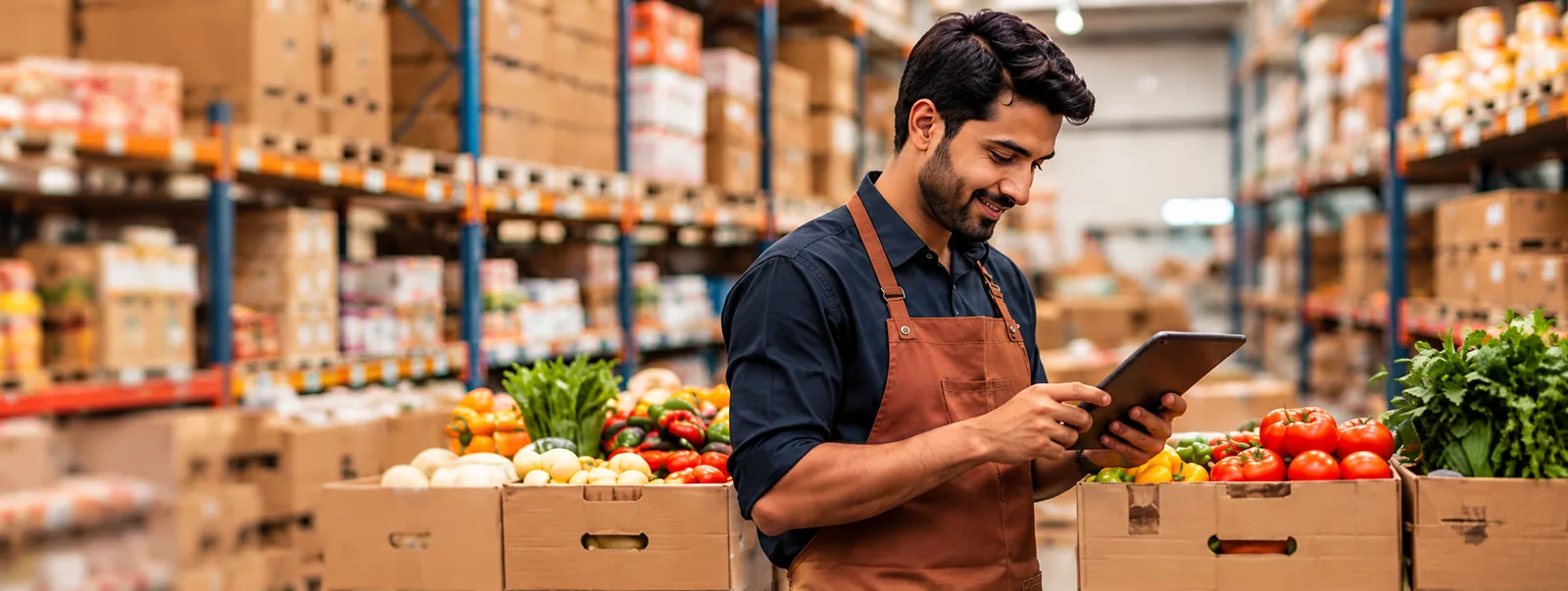
1. Understand the Food Distribution Business
A food distributor buys from manufacturers, brands or wholesalers and supplies retailers, restaurants, hotels, caterers and institutions. You earn the margin between what you pay and what you sell for, so the business lives on three things: steady demand, tight stock and money that comes back on time.
Food has a few habits of its own. Much of it spoils, so stock has to turn quickly. Most customers order small amounts often — daily for milk and bread, weekly for dry goods — and many buy on credit. Pick a lane first: dairy, fruit and vegetables, bakery, packaged foods, beverages or kitchen supplies for restaurants. Each has its own margins, storage needs and buying rhythm.
With the right systems, you can manage orders, inventory, billing and payments in one place — and grow your distribution business without more paperwork.
2. Get the Required Licenses and Registrations
Before your first sale, put the paperwork in place. It keeps you legal, lets you claim back the GST you pay, and makes larger customers comfortable buying from you.
GST Registration
Needed once your turnover crosses the limit — ₹40 lakh a year for most suppliers of goods, lower in some states — and for any sale to another state. Without it you can't claim input tax credit.
FSSAI Registration or Licence
Every food business, distributors included. Basic registration for small turnover; a State or Central licence above the limits. Check your band on foscos.fssai.gov.in.
Trade Licence and Shop Registration
From your municipal body and under your state's Shops and Establishments Act, for the godown or office you work from.
Udyam (MSME) and a Current Account
Udyam registration is free and online, and opens MSME schemes and protections. Keep business money in its own current account from day one.
Limits and fees change; check the official portals listed at the end of this article before you apply, or ask your CA.
3. Build a Reliable Supplier Network
Your customers only trust you as much as your supply is steady. Start with two sources for every item that sells daily, so one bad week at a company or wholesaler doesn't empty your shelves. Negotiate on what you can commit to — volumes, payment days, the order day — not just on price.

Tips for working with suppliers:
- Compare prices from more than one supplier
- Check product quality and expiry on every delivery
- Agree clear payment terms in writing
- Pay on the day you promised — it earns better rates later
4. Manage Inventory Efficiently
Stock is cash sitting on shelves. Too little and you lose the order; too much and it expires. Keep a count you can trust: what came in, what went out on invoices, what was damaged, and a physical count every week for fast items. Set a low-stock level for each item you can't afford to run out of, and sell the oldest stock first.
- Count what moves fastest most often — daily items weekly, slow items monthly.
- Record damage and returns the day they happen, not at month end.
- Know your reorder point for each item, from how much sells between deliveries.
5. Use Technology to Simplify Operations
A modern distribution business needs one reliable system for orders, stock, billing and payments. Typing the same order into a notebook, a billing program and a khata is where most mistakes and missed payments come from.
With Billzova Trade, orders become GST invoices in a tap, invoices take stock out by themselves, and every customer's khata stays up to date — on your phone or your office computer.
Grow your distribution business with Billzova Trade
- Orders from your office and salesmen
- Stock with low-stock alerts
- GST invoices and credit notes
- Khata, dues and payment reminders
- Works on phone, desktop and tablet
6. Focus on Customer Relationships
Restaurants, hotels and shops stay with the supplier who turns up on time, with the right goods, at the price agreed. Deliver on a fixed day, tell customers early when an item is short, and make it easy for them to order and to pay. Give credit carefully — agree a limit and a number of days for each customer, and follow up on dues every week, politely and on time.
Conclusion
Starting a food distribution business in India can be very rewarding with the right licences, a reliable supplier network, careful stock and the right tools. Billzova Trade helps you simplify the daily work — orders, invoices, stock and dues — so you can focus on what matters most: your customers.
Where to check the rules
Limits and fees change. These official sites have the current ones (checked 28 Oct 2026).